AI Work­force Trans­formation | Strategic Work­force Planning

“We translate AI’s impact on your workforce into reliable figures and clear actions, so you know which roles are changing, which capabilities you need to build, and where to invest in a targeted way.”

THE TYPICAL STARTING POINT

Many companies sense that AI is changing their workforce, but they do not know how significantly, how quickly, or in which areas. Workforce decisions are based on assumptions rather than facts. For more than 20 years, Breitenstein has supported organi­zations at precisely this intersection: between what is technologically possible and what people and organizations can realistically sustain.

We support your HR function in workforce transformation, with a focus on AI and digitalization.

WHAT WE MEAN BY THIS

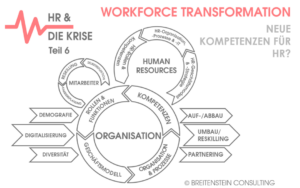
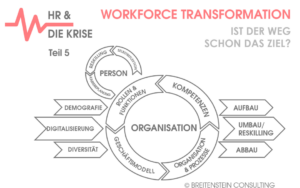
For us, workforce transformation means understanding how AI changes tasks, roles, and capabilities – and deriving concrete workforce decisions from these insights. We support mid-sized companies, corporations, and public-sector organizations in systematically preparing their workforce for the requirements of tomorrow. There is no standard program: every solution is tailored to your specific situation.

OUR APPROACH

Step by step toward a future-ready workforce

How will AI really change your workforce? Our strategic workforce planning consulting begins where technology projects often end: with people. Our five-step model is clear, pragmatic, and adaptable to your situation.

1 | Scope and workforce baseline
Together, we clarify the target vision and the question to be answered: Which areas, job families, and time horizons are relevant? We then create a reliable data foundation covering headcount, costs, critical roles, and the current skills landscape. Data privacy and employee representation are involved from the outset.
2 | Analyze trends and impact
Which forces are affecting your workforce? AI is one of them, but not the only one. Market shifts, automation, and digitalization gaps all feed into the analysis. We break roles down into task clusters, identify the elements that are suitable for AI, and create a risk-and-opportunity profile for each role cluster.
3 | Define target skill profiles and the capability model
Based on BSC’s proprietary capability model, we derive the capabilities that will be needed. The model comprises four core areas and three development levels and can be customized to your organization. We conduct a skills gap analysis for each area, function, and role and prioritize the future skills with the greatest leverage.
4 | Develop the workforce roadmap
We develop scenarios with concrete cost and capacity implications. Our action logic follows four fundamental questions: Who should we develop internally? Who should we recruit externally? Where should we establish partnerships? What should we automate? The result is a management decision document with clear options, consequences, and a recommendation.
5 | Implement and embed
We design reskilling and upskilling programs with a learning architecture, learning paths, and certification. HR tools are aligned accordingly. We set up an HR dashboard that makes capability development, internal mobility, and time to fill measurable. We also ensure effective change communication and stakeholder involvement.

For us, change is only successful when it is firmly established in practice and produces measurable results for your company.

OUR SERVICES

Our service modules for AI workforce transformation and strategic workforce planning

Workforce analysis and workforce baseline

  • Assess the current situation: number of positions, costs, critical roles, and turnover
  • Create a skills map of the current workforce
  • Involve data privacy and employee representation at an early stage

AI impact analysis and task decomposition

  • Which tasks will be automated, changed, or newly created?
  • Create an overview of impact, criticality, and timeline for each role cluster
  • Develop a risk-and-opportunity profile for each area

Workforce scenarios and workforce roadmap

  • Develop three scenarios – conser­vative, baseline, and accelerated – with their cost and capacity implications
  • Define an action logic for each role group: build, hire, borrow, or automate
  • Prepare a decision-making document for management with clear options and a recommendation

AI capability model and skill profiles

  • Define role-specific future capabilities based on BSC’s proprietary framework, comprising four core areas and three development levels
  • Conduct a capability gap analysis: Where are we today, and where do we need to be in 12 to 36 months?
  • Prioritize the future skills with the greatest leverage

Learning archi­tecture and development programs

  • Establish a progression model – beginner, practitioner, and driver – with modular learning paths and certification
  • Connect learning activities to business needs and existing HR systems and processes
  • Develop reskilling and upskilling programs with measurable milestones

HR dashboard and workforce governance

  • Set up a KPI dashboard covering capability development, internal mobility, and time to fill
  • Realign recruiting profiles, retention measures, and compensation
  • Ensure effective change communi­cation and employee representative involvement

FROM PRACTICE

Frequently Asked Questions and Answers

“How will AI change our workforce over the next two to three years, and can we quantify the impact?”

AI is changing tasks faster than traditional planning cycles can capture. Organizations that fail to develop a reliable workforce perspective today make workforce decisions based on flawed assumptions – and ultimately pay the price through higher costs, talent loss, and competitive disadvantages.

“We assume that we will need 20 percent fewer employees. But is that really true, or will the main impact be changes to existing roles?”

The reality is more nuanced: jobs do not necessarily disappear; tasks change. Organizations that fail to distinguish between the two risk losing talent they actually need. Our job decomposition analysis shows what is really changing.

“What will AI specifi­cally mean for our workforce cost situation if we use it consistently?”

Cost and capacity implications can be mapped in concrete scenarios. We provide numbers rather than gut-based estimates and make decisions transparent and comprehensible for decision-making bodies.

“Which capabilities will we need in the future, and how can we develop them without losing talent?”

An HR dashboard that makes capability gaps visible is the first step. The second is a learning architecture that genuinely works – with clear learning paths, certification, and a direct connection to business needs.

“Our competitors are already moving forward. How can we get on the right track quickly enough?”

Speed comes from clarity. We create the foundation for sound, sustainable decisions and support implementation through to lasting integration.

AI WORKFORCE TRANSFORMATION

The results you will receive

  • A reliable workforce roadmap for strategic workforce planning in the age of AI
  • A proven capability model that makes skill gaps visible and guides development activities
  • HR tools and an HR dashboard that make progress measurable
  • Leaders and HR teams equipped to actively shape workforce transformation
  • Organizational change capability for future challenges arising from AI and digitalization

Build a future-ready workforce and master the challenges of the AI era.

Further insights on the topic

Organisationsentwicklung

Restrukturierung umsetzen und Vision verwirklichen

  • Gesamtsicht: Strukturreform & geistlicher Prozess gemeinsam denken
  • Perspektivenvielfalt:  Finanzen, Personal & Kommunikation als Querschnittsthemen mitdenken
  • Spannungsfelder: Linien- und Projektlogik austarieren, Synodalität ermöglichen und Leitung wahrnehmen, Schnelligkeit und Partizipation vereinbaren
  • Begleitung: Interne Leitung befähigen und begleiten